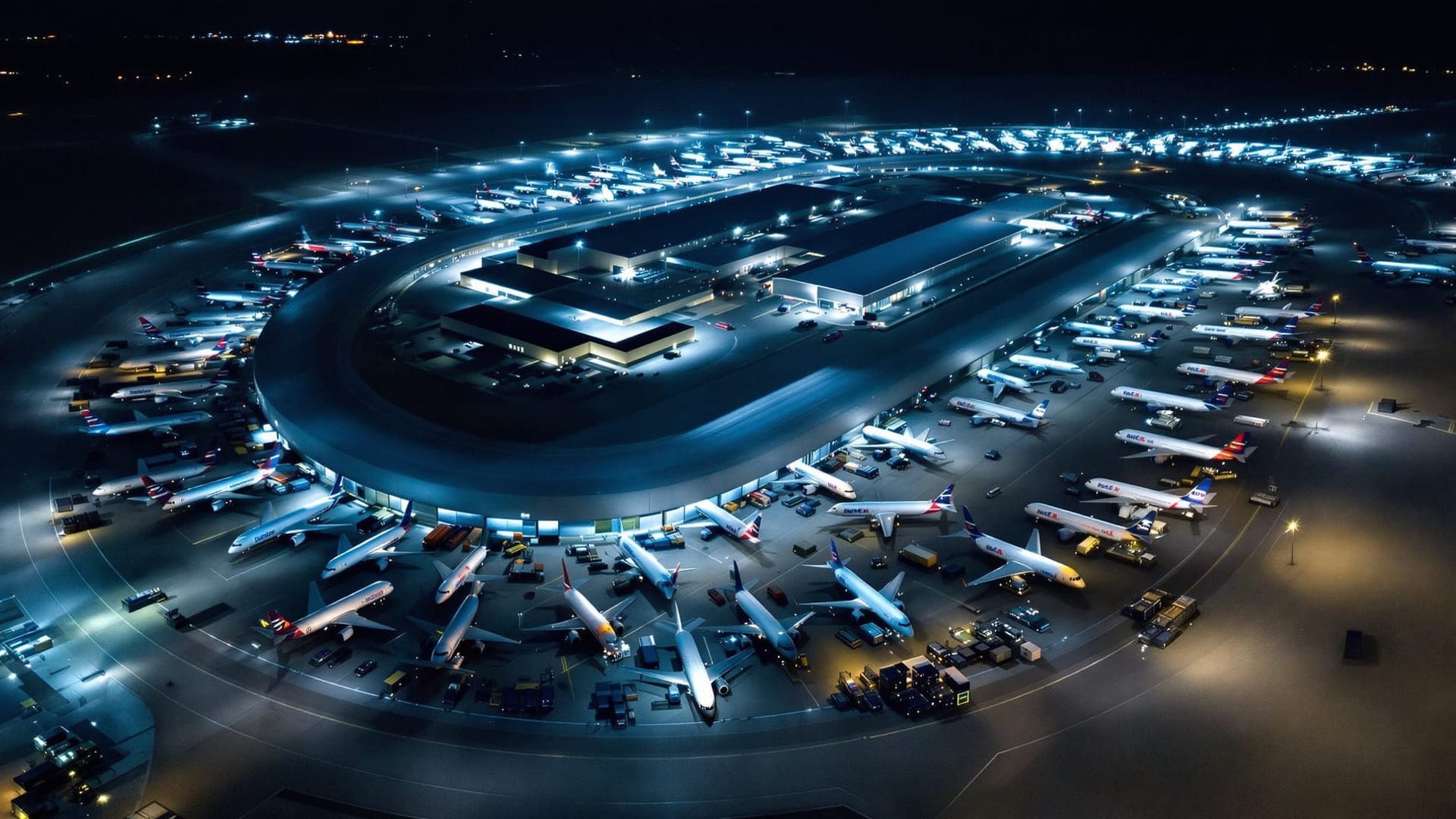
The Sort Window
The domestic express model is hub-and-spoke: freight is flown from everywhere to a central sort in the late evening, sorted in a window of a few hours, and flown back out before dawn so it is on a van by mid-morning. Everything about the crew experience follows from that. Departures cluster. Arrivals cluster harder. The ramp goes from empty to saturated to empty again inside four hours. And a delay is not absorbed by slack in the system, because there is none — it is absorbed by somebody's package missing the sort.
The rhythm this produces is a lot of short sectors, a lot of night duties, and layovers that are either a few hours in an outstation hotel or a full day sitting at a hub. It is the closest thing in aviation to shift work, with all of the circadian consequences that implies.
Weather by Region
Domestic operations mean flying the whole continent's weather in one week.
- Great Lakes and Northeast: lake-effect snow, ice and long de-icing queues from November to March.
- Plains and Midwest: convective season from spring into summer, with squall lines that close whole corridors.
- Southeast and Gulf: thunderstorms most summer afternoons and tropical systems in season.
- Mountain West: terrain, density altitude, and mountain wave.
- West Coast: marine layer and low-visibility approaches, plus wildfire smoke as a genuine seasonal operational factor.
The Aviation Weather Center is the primary source, and the National Weather Service the wider one.
The Outstations
Domestic freight touches a lot of small and medium fields that see little else at night: a single freighter, a handful of ground staff, one van, and a terminal that is closed. Practical consequences worth knowing before you get there — no food after arrival, limited or no facilities airside, ground handling by a small contractor, and a walk across a dark ramp in weather. These are also, frequently, the friendliest stations on the network.
Ramp Culture
US cargo ramps are heavily unionised, tightly proceduralised and generally very safe when the procedures are followed. The hazards are the universal ones — ground equipment, loading, jet blast, high-visibility discipline — and they are on Airport Safety. The domestic-specific point is volume: during the sort there is more equipment moving in a small space than almost anywhere else in the world.
Layovers
Hub layovers are long and often in a hotel belt with a car park, a chain restaurant and a six-lane road with no pavement. Getting anywhere without a car is the standard domestic problem; rental cars and ride-hailing are the standard answers, and a rental on a long layover is often cheaper than the taxis it replaces. Outstation layovers are the opposite — small-town, walkable, closed by nine.
For the eastern seaboard specifically, which has its own weather and its own congestion problems, see East Coast.
Practical Notes
- Crew screening and airport access are governed by the TSA; carry the credentials your operator requires and expect them to be checked.
- Rest rules for US operations differ substantially between Part 121 supplemental, Part 121 domestic and Part 135. Know which one your duty is being built under.
- Distances between a hotel and anything else are the defining domestic inconvenience.
- 24-hour food is easier than in Europe and harder than in Asia.